Posts

Showing posts with the label EI

Working with WSO2 carbon Admin Services
Image
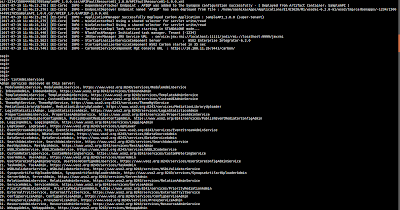
WSO2 products managed internally using defined SOAP web services named as admin services. This blog will describe how to call the admin services and perform operation with out using the Management Console. Note - I will be using WSO2 Enterprise Integrator to demonstrate this. Lets look at how to access the admin services in wso2 products. By default the admin services are hidden from the user. To enable the admin services, 1. Go to <EI_HOME>/conf/carbon.xml and enable admin services as follows <HideAdminServiceWSDLs>false</HideAdminServiceWSDLs> 2. Now start the EI server using ./integrator.sh -DosgiConsole When the server is started click 'Enter' and you will be directed to the osgi console mode. 3. To search the available admin services, Add 'listAdminServices' in the osgi console.This will list down the available admin services with the URL to access the admin services. Access Admin Service via SOAP UI 4. You can ac...

How to use nested UDTs with WSO2 DSS

WSO2 Data Services Server(DSS) is a platform for integrating data stores, creating composite data views and hosting data in different sources such as REST style web resources. This blog guides you through the process of extracting the data using a data services when nested User Defined Types (UDT) used in a function. Lets take the following oracle package that returns a nested UDT. When a nested UDT (A UDT that use standard data types and other UDT in it) exists in the oracle package, oracle package should be written in a way that it returns a single ref cursor, as DSS do not support nested UDTs out of the box. Lets take the following oracle package that includes a nested UDT called 'dType4'. In this example I have used Oracle DUAL Table to represent the results of multiple types included in the 'dType4'. Sample Oracle Package create or replace TYPE dType1 IS Object (City VARCHAR2(100 CHAR) ,Country VARCHAR2(2000 CHAR)); / create or replace TYPE dType2 IS T...